to prepare one document set
Reducing document-set preparation from one hour to 9 minutes.
A web system for the lift inspection workflow in a testing laboratory.
inspections and document sets per year
moved out of manual work
Context
The problem was not one document, but the entire connected workflow.
Each inspection required manual journal entries, measuring equipment records, and separate preparation of an act and protocol. Re-entering the same data took about an hour and introduced typos and inconsistencies within a document set.
Before
- data was copied across several documents
- journal and equipment records were maintained manually
- acts and protocols were prepared separately
- one set took about 60 minutes
After launch
- one source of data for the whole set
- journal and equipment records are built into the flow
- acts and protocols are generated by the system
- a complete set is ready in 9 minutes
Solution
One operating environment instead of disconnected manual steps.
The system leads the user from source data and inspection results to a finished set. Related fields are reused, keeping the act, protocol, and journal consistent.
Inspection
Structured result entry and required-data validation.
Documents
Automatic act and protocol generation from one data model.
Journal
Completed work recorded without repeated manual entry.
Equipment
Measuring instrument records linked to each inspection.
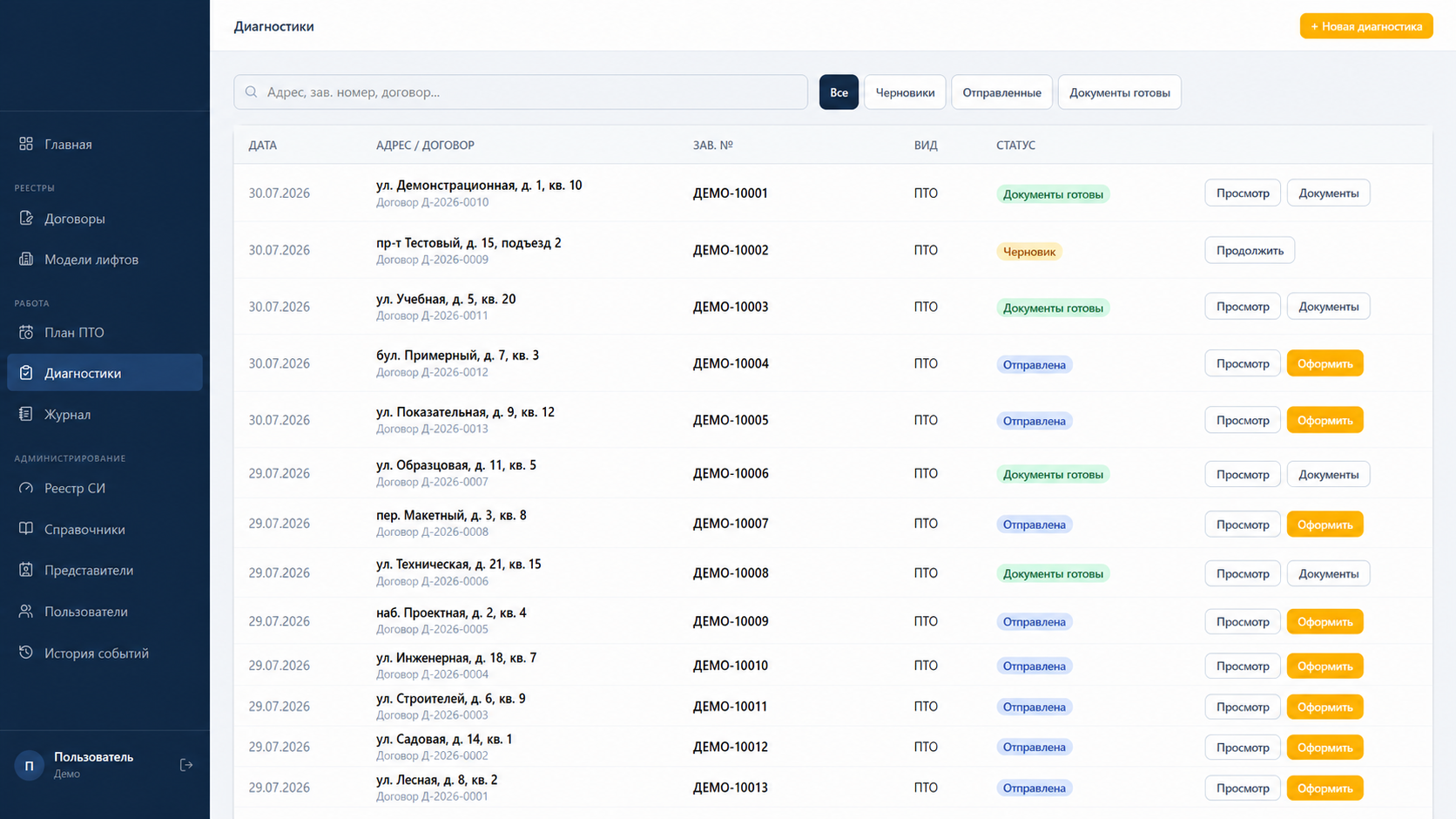
Interface
The system in everyday use.
Desktop and mobile scenarios within one workflow. Operational data in the images has been replaced with demonstration values.
My work
Led the product through the full development cycle alone.
I collected and interpreted the source documents, mapped the real workflow, designed its model, and built the product independently. My scope covered requirements, UX/UI, architecture, interfaces, backend logic, the database, document generation, testing, launch, and continued development in operation.
Less manual work, faster output, consistent data.
Preparation time fell by 85%. Manual journal management, measuring equipment records, and separate act and protocol assembly moved into the system. Typos and inconsistent data within a set were eliminated.
The laboratory name and operational data remain confidential. The published metrics are approved by the process owner.Have a similar process to automate?
Let’s discuss the source data, bottlenecks, and a realistic first product stage.